The 2026 promo rates and the ₱10M ceiling
What are the current promotional rates?
For borrowers who do not fall under 4PH: 4.5% for loans up to ₱4.9 million, whether house and lot or condo, and 5.75% for loans over ₱4.9 million up to the new ₱10 million ceiling. Both promo rates are fixed for the first 3 years of the loan, after which the rate is repriced based on prevailing Pag-IBIG rates. The promo is covered by Pag-IBIG Circular 494.
Until when can I apply for the promo rates?
Applications for the promotional rates can be submitted until December 31, 2026. They apply to new housing loan applications only. Existing loans that are already amortizing cannot be repriced into the promo, though an existing borrower may apply for a new housing loan subject to Pag-IBIG's credit investigation and income evaluation.
Can the 4.5% fixed period be extended beyond 3 years?
Not under the current guidelines. The 4.5% is fixed for 3 years only, and the rate on the 4th year onward follows the prevailing Pag-IBIG guidelines at that time.
How much can I borrow under the regular housing loan, and is there a required salary?
The regular housing loan now goes up to a maximum of ₱10 million. Yes, there is an income requirement, and it scales with the loan amount. Your gross monthly income is assessed at the time you submit your application, so a recent salary increase counts as long as it is your salary when you apply.
The Expanded 4PH Program and the 3% rate
Who qualifies for the 3% interest rate under the Expanded 4PH Program?
You must be a first-time homebuyer with no existing housing loan, and your income must fall within the 7th income decile: gross monthly income of up to ₱47,855 if working in NCR, or up to ₱34,685 if working outside NCR. If there is a co-borrower, the combined gross monthly income of the principal borrower and co-borrower is what gets measured against the ceiling. If the combined income goes over it, you no longer qualify for the 3%, but you can still avail of the promotional rates, which run until December 31, 2026. Pag-IBIG Fund conducts the credit and background investigation, and the borrower signs an affidavit of first-time homeownership.
How long does the 3% rate last? I've heard both 5 years and 10 years.
Under the standard 4PH guidelines, the 3% rate is subsidized for the first 5 years and can be extended for another 5 years if the borrower is still within the income decile after year 5. However, there is currently an early bird promo that automatically locks in 3% for a full 10 years for the first 30,000 borrowers who start amortizing. This was one of the most asked questions of the session.
Which properties are covered by 4PH?
Only projects
accredited under 4PH by DHSUD qualify: socialized house and lot up to ₱950,000, and socialized condo units up to ₱1.8 million. Lot-only purchases are not covered, and resale units bought from private individuals fall under the regular housing loan instead. You can browse all accredited 4PH projects nationwide and sign up through the official listing at
pagibigfundservices.com/MagpalistaSa4PH. After you register, Pag-IBIG Fund evaluates your pre-qualification and sends the results and next steps by SMS or email.
My spouse has an existing housing loan. Can I still avail of 4PH?
No. Spouses are treated as one for 4PH purposes since the property is conjugal, so if one spouse has an existing housing loan the couple no longer qualifies as first-time homebuyers. The good news is you may still qualify for Pag-IBIG's affordable housing at 3% or the promotional rates of 4.5% and 5.75% depending on the loan.
Do existing MPL, calamity, or SAFE loans disqualify me from 4PH?
No. Existing short-term loans do not disqualify you, as long as your payments are updated. There is no need to fully pay them off first.
What if I inherited property, or our lot is still under my parents' name?
If the property was inherited (pamana), you can still avail under the Expanded 4PH. If you are buying your parents' house and lot, or building on a lot under their name, that goes through the regular housing loan with a Special Power of Attorney from the parents and siblings allowing the property to be used as collateral.
Can one borrower take two properties under 4PH?
No. Multiple availments under 4PH are not allowed. One qualified borrower, one 4PH property.
Applying: loan purposes, requirements, and process
What can a Pag-IBIG housing loan be used for besides buying a house?
Quite a lot. Loan purposes include purchase of a residential unit or lot, house construction, home improvement or renovation, and refinancing an existing housing loan from a bank. Combinations are allowed too, such as refinancing plus home improvement, or lot purchase plus construction in one loan. For renovations that affect the structural integrity of the unit, approved building plans, permits, and costing and specifications are required.
Can I transfer my existing bank housing loan to Pag-IBIG?
Yes. This is called refinancing of an existing housing loan from other financing institutions. The key requirement on top of the usual income and technical documents is your latest Statement of Account from the bank. You can even add a renovation amount on top of the refinanced balance.
How long does approval take, and what fees should I expect?
The standard processing time is 20 working days from complete submission of requirements to the issuance of the Notice of Approval. Fees are modest: a ₱3,000 processing fee and a ₱1,000 appraisal fee.
What insurance comes with the loan, and what happens if the borrower passes away?
Non-life insurance on the property is included in the loan. Insurance on the borrower (SRI/MRI) is optional and simply tacked into the monthly amortization. If a borrower with SRI/MRI passes away while payments are updated, the loan is treated as fully paid and the property goes to the legal beneficiaries. Without SRI/MRI, the heirs may continue paying the amortization. If the account is not updated at the time of death, the insurance may not apply and the property can eventually be foreclosed, so keeping amortizations current matters.
I'm married. Can I take out the loan without involving my spouse?
If the property is conjugal, no. The consent of the spouse is required for the housing loan, and if the spouse cannot sign personally, a Special Power of Attorney is needed. For OFW borrowers, there is no need to be physically in the Philippines; the SPA arrangement covers the signing.
If I come into extra money, can I pay down the loan?
Yes. Extra payments can be applied directly to principal, which shortens your loan term and reduces total interest paid.
Acquired assets: auctions and negotiated sale
What does "as is, where is" mean when buying an acquired asset?
You get the property in whatever physical and occupancy condition it is in. The essential details, including net selling price, occupancy status, and property type, are posted on the official Pag-IBIG website for each listing, and Pag-IBIG strongly encourages a site visit before you bid.
What if the unit I won at auction is occupied and the occupant won't leave?
First, coordinate with the homeowners association or barangay to talk to the occupant. If they still refuse to leave, the remedy is a joint filing of an ejectment case: you engage your own lawyer and Pag-IBIG's counsel files jointly with you. Occupancy status is shown on the website before you bid, so factor it into your decision. If you have not yet paid the reservation fee or bid bond, you can also choose not to proceed by emailing the Marketing and Sales Division.
How does payment and move-in work for acquired assets?
A bid bond of 3% of your offered amount is required to participate in a public auction, and no discount applies in the first auction. Payment can be cash, short-term installment, or long-term installment. After you submit complete housing loan requirements, allow 20 working days for credit investigation and evaluation, then you will receive notice for contract signing and an authority to move in.
For employers: the group sale program
How does the group sale program work for companies?
A company partners with Pag-IBIG so employees can acquire acquired-asset properties as a group. The group submits a consolidated Offer to Purchase of at least ₱10 million for the first batch of the year, and the company signs a Collection Servicing Agreement since amortizations are collected through salary deduction.
What happens if an employee in the group sale resigns?
Once the employee has signed their contract, their resignation does not affect the rest of the group's availment. The departing employee simply continues paying Pag-IBIG directly through accredited payment channels instead of salary deduction.
Who do we contact to set up a partnership or verify if our company is enrolled?
You can reach Ms. Faith Macanang of the Pag-IBIG NCR Acquired Assets Sales Group at
gdmacanang@pagibigfund.gov.ph. Individuals are welcome to reach out too, and her team will route you to the right group. If you would like Zalamea to arrange a dedicated session for your company, email us at
marketing@zalamea.ph.
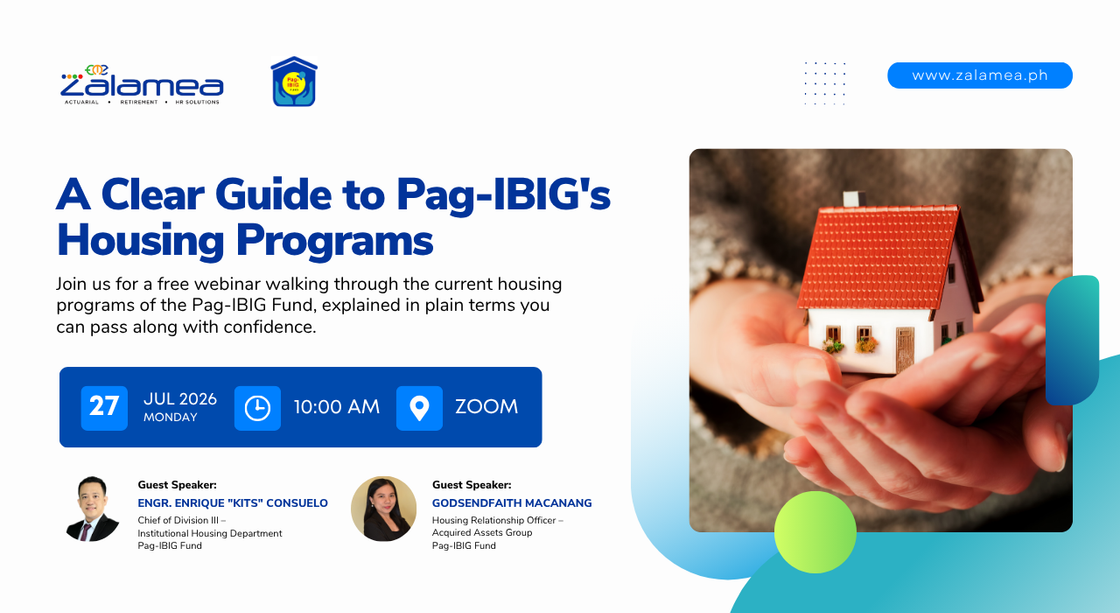
The answers above were provided by the Pag-IBIG Fund team during the July 27, 2026 session and reflect the guidelines in effect at that time. Programs, rates, and rules change, so please verify current terms with the Pag-IBIG Fund before making decisions.