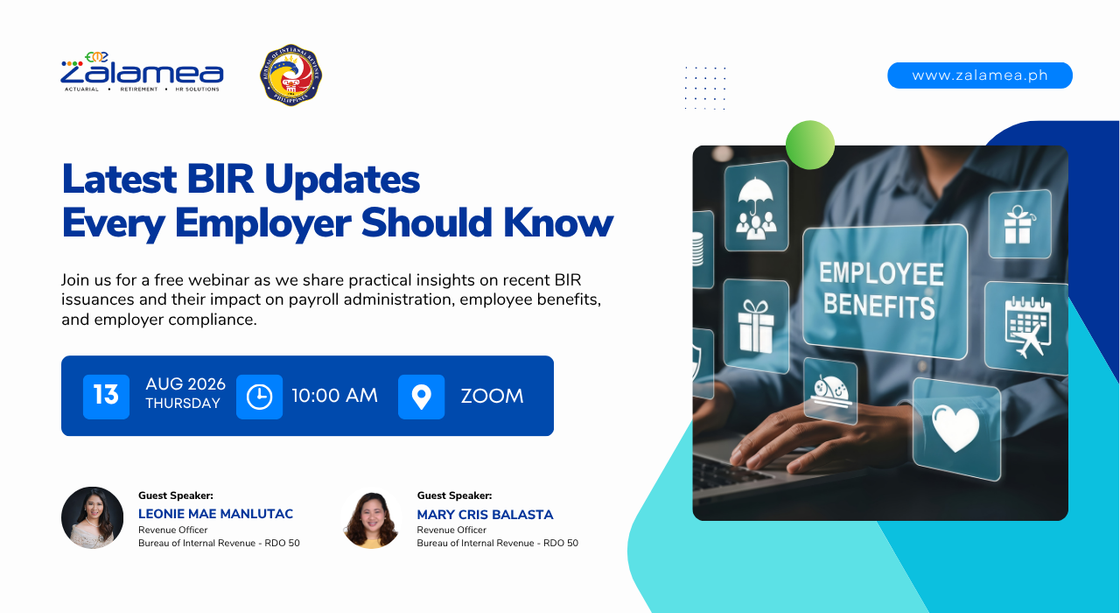
Thank you for joining our free webinar with the Bureau of Internal Revenue on the new de minimis ceilings, substituted filing, and the CMEPA deduction for employers who contribute to PERA. Close to fifty questions came in. Here are the fifteen that came up most, with the issuance behind each answer so you can look it up yourself.
These are the questions that came up most often during the session. Each answer notes the regulation or circular it rests on, so you can pull the issuance and read it in full.
The higher ceilings apply to taxable year 2026, not to 2025. This caused real confusion when the issuance landed in December, so it is worth being clear: nothing needed to be restated for 2025.
If your payroll is system based, check that the new limits were actually loaded effective January 2026. RR 29-2025 amends RR 2-98, which remains the governing regulation on compensation and withholding.
Private employees: only monetized unused vacation leave of up to 12 days a year is de minimis. Anything beyond the 12 days, and any monetized sick leave, falls into taxable other benefits, where it can still be covered by the ₱90,000 ceiling if that ceiling has not been used up by the 13th month pay.
Government employees: the actual monetized value of unused vacation and sick leave credits is non taxable, with no day limit.
The 12 day limit is one of the items RR 29-2025 left unchanged, so it stands as it was going into 2026.
Yes. Whether you roll out the increase in January or in September, taxability is determined for the whole taxable year. The annual ceiling is measured against the year, not against the month you started giving the benefit.
No. These are two separate thresholds. De minimis benefits have their own ceilings under RR 29-2025, and the ₱90,000 is a separate exclusion for 13th month pay and other benefits.
What connects them is the excess. Give a de minimis benefit above its own limit, say rice subsidy beyond ₱2,500 a month, and the excess moves into taxable other benefits, where it competes with the 13th month pay for the same ₱90,000.
It depends on how your policy defines PTO. The rules are written around vacation leave, so you have to look at what your PTO actually stands for. If it functions as vacation leave under your policy, the monetized unused portion can be treated the same way, subject to the same 12 day limit.
PTO is common in multinationals and usually maps to VL, but the classification in your own leave policy is what governs.
₱90,000 is exempt and the ₱35,000 excess is taxable. Remember that the ceiling is shared: it covers 13th month pay and other benefits combined, so any other benefits received during the year eat into the same ₱90,000 before you get to the 13th month.
Yes, and it is expected. On separation you annualize on the day the last payment of compensation is made. Because the annual computation applies the ₱250,000 exempt amount and the ₱90,000 ceiling against the full year, the annualized tax is often lower than the sum of the monthly withholdings.
You refund the excess to the employee in the final pay, and the amount refunded is adjusted against your remittance for that period. For employees still with you at year end, the same logic applies in December: the withholding for the last payroll should be whatever the annualization says is still due, not an amount taken off the withholding tax table. Any refund is due on or before January 25.
An employee must meet all of these: purely compensation income, from only one employer in the Philippines for the calendar year, tax correctly withheld so that tax due equals tax withheld, and a spouse who also meets the same conditions.
So on the cases raised during the session: an employee whose spouse has a business is out, even if the employee is not a co owner or partner. An employee who worked for another employer earlier in the same calendar year is out, because that is two employers successively within the year. An employee who was on payroll and later billed the same company a consultancy fee is out, because that fee is professional income subject to expanded withholding, not compensation.
Anyone who falls out files their own BIR Form 1700, with their Forms 2316 attached.
No penalty on the employer. Once the employee is out of substituted filing, the obligation to file BIR Form 1700 sits with the employee, and so do the late filing penalty and any penalty on unpaid tax.
What HR and accounting should do is identify these employees during annualization and tell them early, with their 2316 in hand so the computation is quick.
This one is genuinely difficult, because RMC 29-2024 disallows submission of certificates without the employee's signature.
Two things help. Electronic signatures are allowed on BIR Form 2316 under RMC 29-2021, so a departing employee can sign before they lose access. And since the 2316 is required to be issued upon separation anyway, the practical fix is to build the signing into your clearance process rather than chasing it in January.
Where an employee has genuinely become uncontactable, document the efforts you made and raise it with your RDO ahead of the February 28 submission.
Not through eAFS. The signed Forms 2316 are submitted on CD or USB, following RR 16-2021 as clarified by RMC 117-2021, together with a notarized sworn declaration from the employer listing the employees covered by substituted filing with their gross income and the corresponding taxes withheld, plus a separate sworn statement for the employees not covered whose 2316 are also being submitted.
What gets stamped manually is the employer's certified list, not each individual 2316. The deadline is February 28, after furnishing the 2316 to employees by January 31. Keep the signed copies for ten years.
It is not required. PERA is a voluntary retirement account for individuals, and any individual with a TIN can open one, so that covers all of your employees. What the government is encouraging, through the BSP and the BIR, is for companies to help their employees enroll and to contribute so the voluntary savings actually grow.
On the credit, the contributor earns an income tax credit equal to 5% of the qualified PERA contribution. In practice the contributor requests a tax credit certificate from the PERA administrator and hands it to HR, and HR applies it against the employee's withholding tax on compensation, so it comes off what would otherwise be withheld. A contributor may put in more than the annual maximum, but the excess no longer earns the 5% credit.
Per employee. That is why the BIR illustration runs employee by employee rather than in total.
It is also joint between the employee's own contribution and the employer's share, not ₱200,000 each. If the employee puts in ₱180,000, only ₱20,000 of the employer's contribution counts toward the deduction, even if the employer actually contributed more. The ceiling is ₱400,000 for overseas Filipinos.
The employer first deducts the actual amount of its qualified contribution, but only up to the amount that completes the ₱200,000 maximum for that employee.
The additional 50% on top of that has two conditions: the employer must contribute at least as much as the employee contributed, and must contribute to all of its employees' PERA. In the BIR illustration, employee 3 shows the failure case: the employee contributes ₱70,000 and the employer only ₱50,000, so the employer keeps the ₱50,000 deduction but loses the additional 50%.
The employer's qualified contribution is also exempt from withholding tax on compensation, and the administrator issues a certificate of the actual amount contributed. Book it as "Share in Qualified Employee's PERA Contribution" and disclose it in the notes to the financial statements. The regulations cover contributions made from July 1, 2025 onwards.
They are complementary, not alternatives. Your company retirement plan covers your obligation under RA 7641, which is 22.5 days pay per year of service at age 60 with at least 5 years of service. A PERA contribution does not offset that obligation.
So keep the private retirement plan for the minimum required under the law, or improve on it with early retirement at 50 with 10 years of service, then add PERA on top as the voluntary layer that employees drive and the company can match. If you want to talk through how the two fit together for your own plan, email us and we will set up a separate session.
Every answer above points back to one of these. All of them are available on the BIR website under Revenue Issuances.
We run free webinars regularly for HR, finance, and accounting teams, with guest speakers from the BIR, the BSP, and Pag-IBIG. Ask for an invite to the next one, or request a dedicated session for your employees.