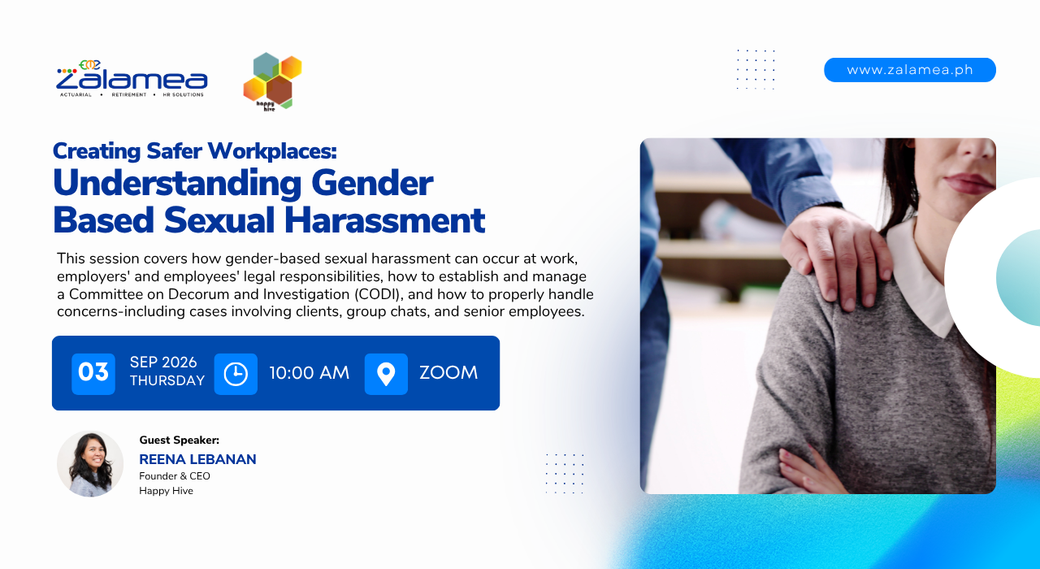
Thank you for joining our free webinar on gender based sexual harassment in the workplace and what the Safe Spaces Act asks of Philippine employers. Nineteen questions came into the Q&A box and many more into the chat, and we could not get to all of them on the hour. Here are the eighteen that came up most, each written to stand on its own, with the law behind it.
These are the questions that came up most often during the session, grouped by theme and written so each answer stands on its own. Each one notes the section of the law it rests on, so you can pull it and read it in full.
Under Republic Act 11313, the Safe Spaces Act, Section 16 covers four forms. First, unwelcome sexual advances, requests or demands for sexual favors that are tied to your work, your opportunities or your performance rating, the classic quid pro quo. Second, sexual or sex based conduct that is unwelcome, unreasonable and offensive, even when nobody asks for anything in return. Third, unwelcome and pervasive conduct that creates an intimidating, hostile or humiliating environment. Fourth, any of the above carried out through technology.
A single incident may not be enough to qualify under the third form. A repeated pattern is.
No, and this is the most common misconception. None of the following is required: physical touching, an explicit request for a sexual favor, a romantic relationship, a superior acting on a subordinate, the incident happening inside the physical office, or the victim complaining right away.
The reach of the law is where it changed most. RA 7877, the Anti Sexual Harassment Act of 1995, was built around authority, influence or moral ascendancy, so it covered a boss and a subordinate. RA 11313 explicitly covers peer to peer and subordinate to superior, and it reaches contractors, part timers, agency staff, suppliers and clients, anyone you deal with in the course of work.
If the jokes are unwelcome and repeated, they can be covered as pervasive conduct creating a hostile environment. Framing them as jokes is not a defense, and it will not hold up in front of a Committee on Decorum and Investigation.
The same applies to the things that usually get filed as banter: a daily comment on someone's body dressed up as a compliment, a rumor that a colleague slept her way into a promotion, a sensitive nickname used in a meeting.
No. You do not have to prove malicious intent. If the conduct was unwelcome and repeated, it falls under pervasive conduct. What an investigation weighs is the effect on the person who received it, not what the other person says they meant by it.
“You do not have to prove the intention of the person who did it. The impact is what matters.”
Reena Lebanan, Founder and Chief Executive Officer, Happy Hive
Yes. Technology assisted conduct is one of the four forms in Section 16. It covers company email, Slack, Viber, Messenger and any other work related communication system, including a personal phone used for work, at any hour of the day.
The law deliberately does not list specific apps. It is written to cover anything that generates, sends or stores the conduct, so it does not go obsolete every time a new platform appears.
Yes. Remarks that mock or express hostility toward a person's sexual orientation or gender identity are covered. This is one reason the law is written as gender based sexual harassment rather than sexual harassment alone, which is how RA 7877 framed it.
Context and impact decide it. The same word can be an endearment between close friends and a slur when it is aimed at someone, which is why these cases are read in context rather than by the word alone.
Not only the office. It covers work events, business trips, trainings and conferences, client activities, work related group chats and any digital communication tied to work. The workplace is not always a physical place.
Section 17 makes it a legal duty rather than a risk management option. Employers must post a copy of the Act in a conspicuous place, provide measures to prevent gender based sexual harassment, and create an independent internal mechanism or a Committee on Decorum and Investigation to receive and act on complaints. The same duty falls on anyone holding authority, influence or moral ascendancy in the workplace, which means managers and officers, not only HR.
Section 19 attaches the numbers. An employer who fails to carry out the Section 17 duties faces a fine of ₱5,000 to ₱10,000. An employer who fails to act on a reported act of gender based sexual harassment faces a fine of ₱10,000 to ₱15,000. Doing nothing is itself the violation.
“If you did nothing as an employer, that is already a violation. It is not optional risk management.”
Reena Lebanan, Founder and Chief Executive Officer, Happy Hive
The Committee on Decorum and Investigation is the company's internal body for receiving, investigating and deciding on complaints. Under Section 17 it must be headed by a woman, and not less than half of its members must be women. It must investigate and decide on a complaint within ten days or less.
Two composition choices make the difference in practice. Include at least one rank and file representative, because colleagues are far more willing to come forward when someone at their own level is in the room. Include at least one decision maker from management, because a finding that management never implements is worth nothing.
On confidentiality, RA 11313 already requires the CODI to handle cases confidentially. You may still ask members to sign a non disclosure agreement, but the obligation exists with or without one.
Section 18 sets four duties. Refrain from committing gender based sexual harassment. Discourage it when you see it rather than letting it run. Report acts you witness in the workplace. Provide emotional or social support to a colleague who has experienced it.
This is the part most companies never communicate. Prevention is not only an HR function.
Ideally HR is not the body that decides it. These cases are specific and sensitive, and there is only so much a generalist HR function can carry alone. The complaint should go to a properly constituted CODI.
If a company has no CODI when an incident happens, HR can convene one, but a CODI needs training, a written policy and management approval before it can do its job well. That work belongs before the first case, not during it.
Yes. Offenses committed under Section 16, the workplace provision, prescribe in five years. An incident from a year or two ago is still actionable.
The CODI is also not the only route. Because RA 11313 is a national law and not just a company rule, a complainant can go to the courts, the police or the barangay.
CCTV is not required to prove that something happened. An investigation is not simply asking the respondent whether they did it. It takes the account of the complainant, looks for a pattern, checks message and email records, and speaks to people who saw the conditions around the incident even if they did not see the incident itself.
Nor should a person who raises a concern be sent away to produce evidence first. Gathering and weighing evidence is the CODI's job, under due process. It is not a burden the complainant carries alone.
You cannot force someone to complain. Consent matters, and the reasons people hold back are real: fear of retaliation, humiliation, or simply not being ready. Pushing a person into a process they did not choose can do more damage than the original incident.
Reporting is also not the only thing available. Coworkers can offer support, and a colleague who says that is not okay, please stop, in the moment, does more than most policies do. Separately, the employer's Section 17 duty to prevent harassment stands on its own, so a company that sees a pattern can still act on the environment through retraining, reminders and policy work even where no individual case has been filed. A disciplinary case against a named respondent is different and still requires due process.
“Harassment is the responsibility of the harasser. We do not blame the victim's clothes.”
Reena Lebanan, Founder and Chief Executive Officer, Happy Hive
This is what the law means by unwelcome and pervasive conduct, and it is the hardest category to see because no single incident stands out. There will always be an alternative explanation available: it was about skill, or the client simply preferred someone else.
This is exactly what a CODI exists for. It puts the pattern in context: how it ran over time, how similarly qualified colleagues were treated, and what was actually said internally when the assignment was decided. A committee headed by a woman, with a rank and file member and a decision maker on it, is far better placed to make that call than a single manager is.
Client activities are part of the workplace under RA 11313, and the law covers clients, contractors, suppliers, agency staff and part timers. Because the Safe Spaces Act is a national law rather than a company policy, the protection does not stop at the edge of your own organization.
The CODI can investigate and refer the matter onward, and it can present the results of its investigation when a court requires them. That is why everything a CODI does has to be documented. If the complainant chooses to take it further, the courts, the police and the barangay are all available, and local government units and the police are mandated to know this law.
The CODI acts for the employer, so a case handled badly is a failure of the employer's Section 17 duty, and Section 19 attaches a fine of ₱10,000 to ₱15,000 to an employer who fails to act on a reported incident. Members who breach confidentiality or act in bad faith can also face the company's own administrative consequences, on the same terms the policy sets for anyone else.
A complainant who is not satisfied with an internal outcome is not stuck with it. Because RA 11313 is a national law, the case can be brought to the courts, the police or the barangay independently of what the CODI decided.
A complaint that is not substantiated is not the same as a false one. Many genuine cases fail on evidence, and treating every unsubstantiated case as a lie is the fastest way to make sure nobody reports again.
Where an investigation establishes that a complaint was knowingly fabricated, that is a matter for the company's own code of conduct and disciplinary process, with the same due process the respondent was entitled to. Write it into the workplace policy in advance, so it is not being decided case by case under pressure.
“A safe workplace is built before something happens, not after.”
Reena Lebanan, Founder and Chief Executive Officer, Happy Hive
RA 11313 does not wait for an incident. An employer that has not posted the Act, put prevention measures in place, or constituted a CODI is already exposed to a fine of ₱5,000 to ₱10,000 under Section 19. An employer that receives a report and does not act faces ₱10,000 to ₱15,000. Those figures are small next to what an unhandled case costs an organization in people, in trust and in time, which is the real reason to build the mechanism before it is needed.
Reena closed with a checklist, a set of roles and five things to remember. If your organization does not have these in place, this is where to start.
Reena's session was an executive summary. The written policy, the CODI, the training and the ongoing advisory are what an organization actually needs. Happy Hive does that work: a workplace safety audit with a written readiness report, Safe Spaces orientation and CODI setup training, and a full program retainer covering policy, a training series and monthly advisory.