Thank you for joining our second free webinar with the Pag-IBIG Fund this year, this time on which housing loan fits you, whether it is your first home or your next one. More than 50 questions came into the Q&A box and many more into the chat, and we could not get to all of them on the hour. Here are the twenty that came up most, with the answers from the Pag-IBIG team.
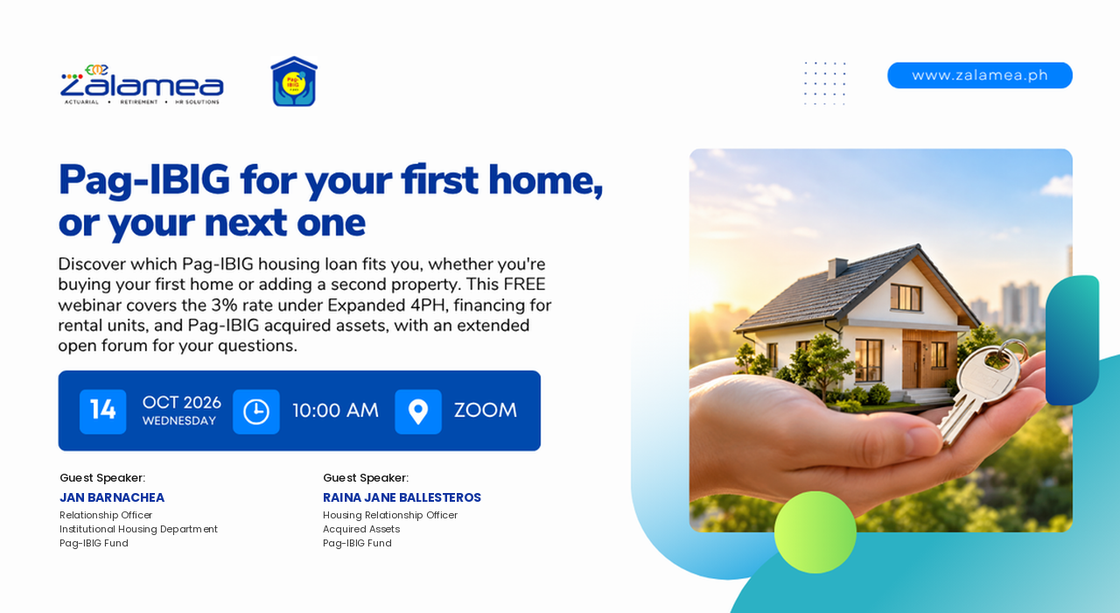
These are the questions that came up most often during the session, grouped by theme and written so each answer stands on its own. The answers come from the Pag-IBIG team, live and in the Q&A box, together with Vernice Lucero, Lili Guerrero and Reychel Avila who answered questions throughout.
You must be a first time homebuyer, owner or grantee with no existing housing loan. If you are married, you and your spouse count as one, so a housing loan in either name means you no longer qualify. Your gross monthly income must fall within the 7th income decile: up to ₱47,855.82 if you work in NCR, or up to ₱34,685.82 if you work outside NCR. OFWs qualify regardless of income.
The property must be in a project accredited under 4PH, priced within the socialized ceilings of ₱950,000 for a house and lot or ₱1.8 million for a condominium unit. You also need at least 12 monthly savings, down from the usual 24, and no Pag-IBIG short term loan in arrears. Accredited projects are listed at pagibigfundservices.com/MagpalistaSa4PH, where you can sign up and get pre qualified.
Under the standard 4PH guidelines, 3% is fixed for the first 5 years and can be extended for another 5 if you are still within the income decile. Right now there is an early bird offer that automatically locks in 3% for the first 10 years for the first 30,000 borrowers. At the time of the session, about 12,000 of those slots had been taken.
While the national government subsidy is available, the effective rate can go as low as 1%. If the subsidy ends, the rate reverts to 3%, not higher. Borrowers in the lowest three income deciles also get the estate management fee and both insurance premiums waived while the subsidy lasts.
Yes. The Affordable Housing Program also carries 3% for the first 5 years and is open to second time homeowners. The difference from 4PH is that there is no subsidy and it is not limited to accredited 4PH projects. It applies to developer units, acquired assets and purchases from an individual seller, as long as the price stays within ₱950,000 for a house and lot or ₱1.8 million for a condominium unit, and your income is within the decile above.
Multiple Pag-IBIG housing loans are allowed as long as your income can carry them and all your existing Pag-IBIG obligations are updated.
Yes. The ₱950,000 and ₱1.8 million ceilings only decide whether you get 3%. Above them you can still borrow, and the loan falls under the promotional rate of 4.5% instead.
Whether a project is socialized is not decided by its price alone. It is what DHSUD declares in the developer's License to Sell. Some developers also ask for an equity payment, because Pag-IBIG lends the lowest of three amounts: the amount you ask for, what your income can support, and the selling price or appraised value of the property.
For borrowers who do not fall under 4PH or the Affordable Housing Program: 4.5% for loans up to ₱4.9 million, whether house and lot or condominium, and 5.75% for loans above ₱4.9 million up to the ₱10 million ceiling. Both are fixed for the first 3 years, then repriced at Pag-IBIG's prevailing rates.
Applications must come in by December 31, 2026. The promo applies to every loan purpose, including house construction and home improvement, and it can also apply to acquired assets. If you submitted your papers through a developer, follow up with them so your application is filed before the deadline.
No. The promotional rates apply to new applications filed within the promo period. A loan that is already amortizing cannot be repriced into it.
It is recomputed using Pag-IBIG's prevailing rate for the fixing period you choose next, so it can go up or down. For reference, the regular rates shown during the session ranged from 5.75% for a 1 year fixing period and 6.25% for 3 years up to 9.75% for a 30 year fixing period.
Up to ₱10 million. Pag-IBIG lends the lowest of your desired loan amount, your capacity to pay, and the selling price or appraised value. For capacity to pay, your monthly amortization should not exceed 35% of your gross monthly income.
Existing loan amortizations are deducted when your disposable income is assessed, which can lower the amount you qualify for. Loans that are almost fully paid may be considered, subject to Pag-IBIG's evaluation. If your income alone is not enough, you can add a co borrower.
The term can run up to 30 years, but the loan must mature before your 70th birthday, and you must be 65 or younger when you apply. The quick math is 70 minus your age, less a little for processing time.
From questions asked during the session: at 46, the maximum is about 23 to 24 years. At 51, about 18 to 19 years. At 56 you can still qualify for the promotional rates as long as you apply within the promo period, just with a shorter term.
Yes, if you have a stable and verifiable source of income and are not more than 65 years old when you apply. You also need at least 12 monthly savings, which you can complete by contributing monthly or in a lump sum. Approval still depends on your capacity to pay and the loan maturity age limit.
Pag-IBIG mainly looks at your obligations with Pag-IBIG itself: multipurpose loans, calamity loans and other housing loans, which need to be updated. The section on bank loans in the application form is optional. For 4PH, Pag-IBIG also checks NHA and SHFC records to confirm you are a first time homeowner.
Borrowers with a foreclosed, cancelled, bought back or voluntarily surrendered Pag-IBIG housing account cannot take a long term housing loan. You can still buy acquired assets through cash or short term installment payable within one year. You may also submit an appeal for reconsideration on meritorious grounds, subject to Pag-IBIG's evaluation.
A foreclosure does not touch your Pag-IBIG savings. Provident savings and housing loans are separate, so your contributions stay yours and can be withdrawn once you qualify, such as at membership maturity after 240 monthly contributions.
“Pag-IBIG Fund is owned by its members, not by anyone else.”
Jan Barnachea, Institutional Housing Department, Pag-IBIG Fund
Yes, through house construction. The title should be in your name. If the lot belongs to a relative, it can still be used for relatives up to the second civil degree of consanguinity, such as parents, grandparents and siblings, or the first civil degree of affinity, such as parents in law. A Special Power of Attorney from the owners allowing the lot to be used as collateral is part of the requirements.
You can see the checklist and apply online through Virtual Pag-IBIG. Processing takes about 20 working days up to the Notice of Approval.
Not while the property is still collateral for the bank. The route is to refinance the bank loan with Pag-IBIG and add home improvement in the same application. Pag-IBIG pays off the outstanding balance with the bank, and you can extend your payment term in the process.
For refinancing you will need the bank's latest Statement of Account showing the loan purpose, original amount and outstanding balance, signed by the manager or account officer, plus either official receipts for the last 6 months or a subsidiary ledger showing no payment later than 30 days in that period.
Yes. Pag-IBIG has no prepayment penalty, and payments applied to principal shorten your term and reduce the interest you pay. The payment should be at least equal to one monthly amortization.
Advance to principal needs a form, so file it at a Pag-IBIG branch and tell them the payment is for principal. Not every branch handles this, so check with your nearest one first. Extra money paid through payment centers or e-wallets is applied as advance payment for your next amortizations, not to principal.
Every Pag-IBIG housing loan carries life insurance and non life insurance in the monthly amortization. If the borrower passes away, the family brings the death certificate to the nearest branch and files a claim, and the loan is treated as fully paid. The debt is not passed on to your children. If there is a co borrower, only the deceased borrower's share is covered.
Non life insurance covers the property itself. If it is damaged by flood or fire, file a claim at the branch with the required documents to receive cash assistance.
“The debt is not passed on. If the borrower passes away, the property is treated as fully paid.”
Raina Jane Ballesteros, Housing Relationship Officer, Pag-IBIG Fund
Pag-IBIG is running a Super Sale until December 31, 2026, and the discount applies whatever your mode of payment: 10% at the first public auction, 20% at the second public auction, and 30% under negotiated sale. Outside the Super Sale, the first auction has no discount and the long term installment discount is lower.
To join an auction, the reservation fee is 3% of your bid plus ₱1,000 for cash or short term installment, or 1% of your bid plus ₱1,000 for a housing loan. Under negotiated sale, a housing loan buyer pays only the ₱1,000 reservation fee. You have 15 days after winning to pay and submit your loan requirements, and each buyer can bid on up to 3 properties a week.
Acquired assets are sold as is, where is, and the occupancy status of each property is shown in its listing, so you can filter for unoccupied units only. Pag-IBIG first sends notices and its legal team talks to the occupant, and many leave once notified, which is why some properties listed as occupied turn out to be empty when you visit.
If the occupant still refuses after you have taken out the property, the remedy is a joint filing of an ejectment case with Pag-IBIG, which supplies the documents and notices, while you engage your own lawyer. Visit the property before bidding and factor this in. If you win and decide not to proceed, you can still walk away before paying the reservation fee.
For houses in a subdivision, you can visit anytime, subject to the subdivision's access rules. For condominium units, email rdballesteros@pagibigfund.gov.ph with the Property ID and address, and Pag-IBIG's Property Management Department will arrange it.
Properties not yet in the official listing are not yet for sale, and Pag-IBIG cannot reserve one for you even if you live next door or know the former owner. Watch the listings on the Pag-IBIG Fund website for the bidding schedule.
A company, employee association or cooperative partners with Pag-IBIG so its members can buy acquired assets together in one transaction. Each employee gets a discount based on the group's total purchases for the calendar year: 40% for ₱10 million to ₱50 million, 42% for more than ₱50 million to ₱100 million, and 45% above ₱100 million.
The company signs a non binding Memorandum of Understanding and a Collection Servicing Agreement, since amortizations are collected through salary deduction, and names a Single Point of Contact, ideally two people, who collects offers and pays fees on behalf of employees. The first batch of the calendar year needs a consolidated Offer to Purchase of at least ₱10 million. If an employee resigns or retires, the loan stays with the employee and the company carries no liability.
A few more things the Pag-IBIG team shared, from how to bid online to what the Fund looks like today.
We run free webinars regularly for HR, finance and accounting teams, with guest speakers from Pag-IBIG, the BIR and the BSP. Ask for an invite to the next one, or request a dedicated session for your employees, including the group sale program.