Thank you for joining our free webinar on what the Safe Spaces Act asks of Philippine employers, and to Reena Lebanan for coming back to walk us through it. The chat and the Q&A box were busy, and we could not get to everything on the hour. Here are the twenty questions that came up most, each written to stand on its own, with the law behind it.
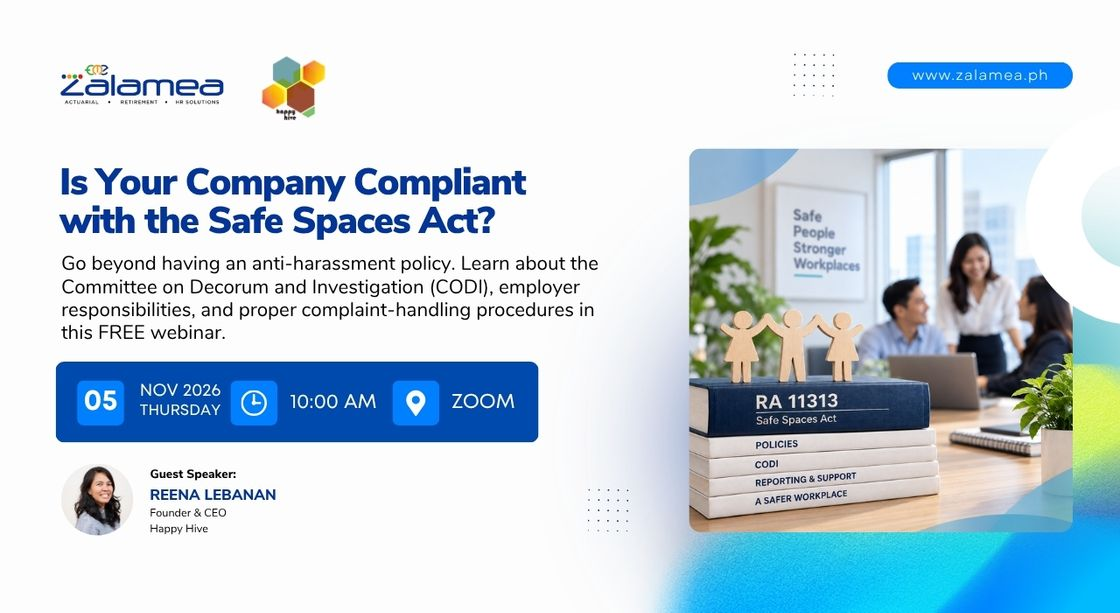
These are the questions that came up most during the session, grouped by theme and written so each answer stands on its own. They are drawn from Reena's slides and from her answers during the live Q&A.
RA 11313, the Safe Spaces Act, was signed on April 17, 2019 and is also known as the Bawal Bastos Law. At work, it covers harassment by a superior, a peer or a subordinate, in person or online.
The older law, RA 7877, needed the harasser to hold power or authority over the victim, usually a boss or supervisor who controls your rating or promotion. Under RA 11313 it does not have to be the boss. A co-worker is covered, and so is harassment from a subordinate toward a superior. Besides the workplace, the law also covers schools, online spaces and public spaces such as streets, parks and transit.
Yes. A co-worker's comments count. So does the group chat. "Joke lang" is not a defense.
In practice this looks like comments about someone's body or appearance, sexist, homophobic or transphobic jokes, repeated invitations after the person has already said no, and unwelcome jokes posted in group chats.
No. The policy is the paper. It is the code of conduct that sets what is not okay and what happens when it occurs, and it is what the CODI bases its investigation and conclusions on.
The CODI is the committee: the actual people and the process that take in reports, investigate and decide what happens in a case. You need both.
“Policies are easy to write. The real test is what happens when someone actually reports.”
Reena Lebanan, CEO, Happy Hive
Section 17 sets four duties, and that is not a lot.
Share the law. Post it and make sure people know it exists. Prevent it. Train people before something happens, not after. Create a CODI. Someone has to hear the complaint. Adopt a code of conduct. Clear rules on what is not okay, and what happens.
Skip these, or ignore a report, and the employer can be held liable under Section 19.
Yes. You do not need a formal complaint to act. Under the Implementing Rules and Regulations, a report is enough notice for the employer, even if it is verbal, anonymous or comes from another person. The employer's obligation is to verify it and refer it to the CODI.
If HR already knows, the company cannot simply wait for a letter. An employer who fails to act on a reported case faces a fine of ₱10,000 to ₱15,000, on top of the cost to the company's reputation if the employee takes it to social media, DOLE or the news instead.
Training is for everyone, at different depths. By law, co-workers and bystanders also have duties: to help prevent harassment, to report what they see and to support the victim. Everyone benefits from a Safe Spaces orientation.
CODI members need deeper training than the general workforce, and that training is required. Since the CODI is required, so is preparing its members to do the job properly, through training and regular meetings. Managers should get deeper training as well.
Yes, and it is a good practice. When you onboard someone you walk them through the company rules, and the anti harassment policy should be one of them. Include who the CODI members are, so new hires know from day one who to go to.
If the CODI members change, post a memo or announce it right away. Small, visible signals add up: the RA 11313 poster in a visible area, regular orientations, and HR being proactive. Employees notice, and they feel safer reporting because of it.
The CODI must be headed by a woman, and at least half its members must be women. It should include management or supervisors, the rank and file, and the union if there is one. No member should have ties to the person being complained about.
Management gives the CODI's findings weight, so recommended sanctions can actually be carried out. Rank and file representation makes employees more comfortable reporting, because someone closer to them is in the room.
In numbers: with three members, which is the practical minimum, at least two should be women. With five, at least three.
Yes. In a male dominated workplace it matters even more that women are represented on the CODI. If you have few women, keep the CODI small rather than dropping the requirement. For example, three members: two women and one man, headed by a woman.
No. The composition stays the same no matter who is complaining: management or supervisor, rank and file, headed by a woman, at least half women. All those positions should be represented at all times.
What can change is the people. A member with a close relationship to the complainant or the respondent, such as a best friend or their own boss, should inhibit from that particular case. This matters because sometimes the person being complained about is the HR head or a senior officer who would normally sit on the CODI.
A memo is okay. That is what DOLE asks for.
Yes. CODI members are not expected to be lawyers, which is exactly why training matters. Focus that training on trauma informed interviewing, how to handle complaints and investigations, and how to reach and write up a decision.
Document everything: the trainings the CODI has gone through, how each investigation went, and the basis for the decision.
“It is not a committee on paper. The CODI is a process that needs to be trusted by the employees.”
Reena Lebanan, CEO, Happy Hive
Listen, document it, explain her options, and check if she is safe. That was option C in the session.
Why not wait until she files a written complaint? Because while you wait for the paper, the harassment may still be happening. Why not tell her to avoid the co-worker? Because Ana should not have to change her own behavior to protect herself. Why not talk to the co-worker informally to settle it? Because tipping off the respondent outside the process breaks due process.
In that first conversation, listen without judgment and record when and how the report was received. Explain the process and help her document the complaint. Check whether she needs protection or a referral. Do not dismiss it as a joke or a misunderstanding, do not promise an outcome or absolute confidentiality, and do not investigate on your own outside the formal process.
This is normal. Many people report verbally just to be heard and to make sure they are safe. The employer still goes through the steps: make sure she is safe, ask whether she wants to file, and explain what the CODI will do if she does. Until she files, the company cannot act formally against the respondent.
There is still a lot the company can do. Run a Safe Spaces orientation for everyone, and make sure the policy and its consequences are clear and communicated. Orientations like these are a strong deterrent, because people see the company will not tolerate harassment.
No. Treating the screenshots as a verdict is prejudging. They are evidence for the CODI to investigate in context.
From the Tama o Mali exercise: messaging the co-worker first to get their side is Mali, because the respondent should learn of the complaint through proper notice, not a chat. Recording the complaint and asking if Ana feels safe is Tama. Giving the co-worker written notice and a chance to answer is Tama, because that is due process.
No. Confidentiality means the case does not spread to people with no business knowing about it. Access is restricted and shared only with authorized persons, for legitimate purposes.
The respondent has to know the allegations. They cannot answer or explain themselves if they do not know what they are answering to. Keeping the allegations secret from the respondent was Mali in the exercise.
The CODI has 10 working days to investigate and decide, counted from the date the formal written complaint is received. That means decided within the ten days, not starting ten days after. Date the complaint when it comes in.
Missing the timeline is already a violation of the Safe Spaces Act, and the employee can take the matter to DOLE or other institutions. That is why templates, rules and forms need to be ready before day one, not on day nine.
The decision is meant to be final, which is why management sits on the CODI: so recommended sanctions can be carried out right away. Either party can appeal with the CODI.
The complainant can also pursue the case outside the company. Because RA 11313 covers more than the workplace, a complainant who is not satisfied can go to the Women's Desk, the barangay or the police.
Retaliation does not need a memo. If, after she reports, Ana stops being invited to meetings or gets moved to another shift without explanation, that is retaliation.
The CODI and the employer must protect complainants and witnesses while the case is ongoing and after. Watching whether the employee is treated differently after reporting was Tama in the exercise.
Start with the CODI. If you do not have one yet, start discussing it and identify who your members could be. The CODI members are the ones who will list down everything else that needs to be done.
Many companies form their CODI after a session like this one, then move on to training the whole organization so everyone knows the CODI exists.
“Each and every one of us can contribute to a safer workplace. We don't have to be HR or owners to create a culture that everyone wants to work in.”
Reena Lebanan, CEO, Happy Hive
Reena closed with an eight point checklist, one point each. 7 to 8: solid. 4 to 6: on paper, not in practice. 0 to 3: start this week. During the session most companies landed between 2 and 6, and that is normal. Whatever your score, fix your lowest one this week. The full checklist is below.
Reena built the session around one case, Ana's, and a set of tools you can use the same week. If your company is not there yet, this is where to start.
It happens when someone like Ana knows where to go, and trusts what happens next. If you need help with your CODI, policy or training, Reena and the Happy Hive team do this work. For payroll and HR support, our team is here.